
View looking southward towards Kursi of an east-west slope terminating near church
ISRAEL PHOTOS III -- A COLLECTION OF PHOTOS FROM ISRAELWITH DESCRIPTIONS OF SCENES AND SITES PERTINENT TO THE STUDY OF CHRISTIANITY |
View looking southward towards Kursi of an east-west
slope terminating near church
Caves along a ridge to the east of Kursi.
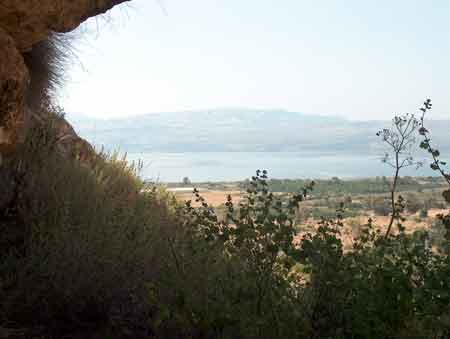
From inside Cave #1, April 2005
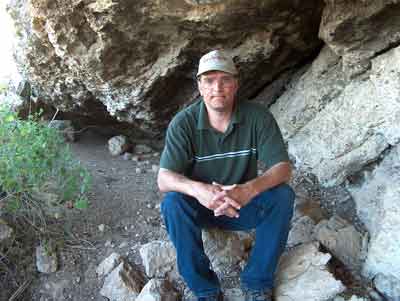
Four foot wide ledge below limestone overhang

Cave #2

Cave #2 low ceiling, conglomerate cave, January
2006
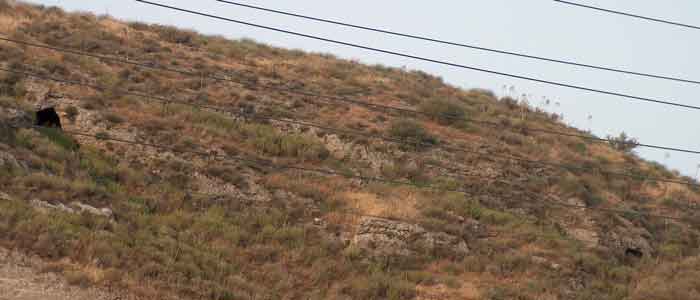
Cave #3, April
2005
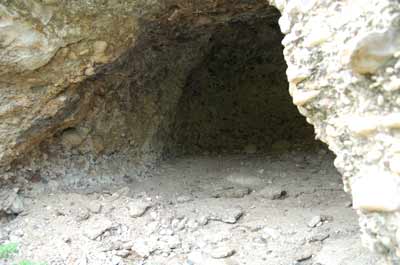
Cave #3 was large enough to stand in, January 2006.
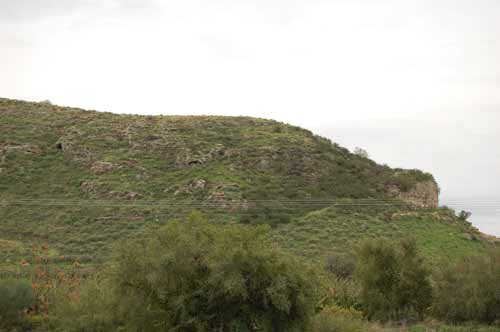
Kursi Hill, shows cave #3 to left and hillside cut dug while
excavating Byzantine chapel, January 2006
I picked up a Franciscan guidebook in a Jerusalem guesthouse library and found mention of recesses in the wadi to the side of the Kursi monastery described as tombs. The study of this area has occurred to try to determine the geographical context of the Gospels and the story about the demoniac. The demoniac was described as a Gerasene in two of the early Gospels, a Gergesene in later manuscripts, and a Gadarene in one of the Gospels. There were limestone cave/overhanging ledges and manmade conglomerate caves along this coast. The rock was solid and the caves might have been hundreds or thousands of years old. They may have been dug into conglomerate,the rock is cemented solid, a rock strata dipping to the west.
There was also a steep slope and numerous caves/tombs in the NW corner of the lake near Magdala and Hawaii Beach.
In 2006 I found a book by W. Sanday, SACRED SITES OF THE GOSPELS, Oxford at the Clarendon Press, 1903. Sanday went to Kursi although the Arabs called it Kersa at that time. Sanday reported seeing tombs and a steep place almost at the edge of the lake. He compared the word Kersa to Geresa.
Sanday quoted the work of one Dr. Thomson, THE LAND AND THE BOOK (1901), who was credited with having discovered the place. Thomson wrote: "The name of this prostrate town is Kerza (sic) or Gersa as my Bedawin guide shouted it in my ear the first time I visited it, on that windy day we have been describing. The name however pronounced by Bedawin Arabs, is so similar to Gergesa, that to all my inquiries for this place, they invariably said it was at Chersa (sic); and they insisted that they were identical, and I agreed with them in this opinion."
Sanday reprinted the work of Dr. K. Furrer, of Zurich: "That Kersa (the first discoverer of the place, Thomson, writes Gersa, Schumacher Kursi) may, so far as the sounds are concerned, be identified with Gerasa ... That there was a place Gerasa (Origen thought that it should be written Gergesa) on the eastern shore of the lake was known only to Origen, who on his repeated journeys to Bostra may have been acquainted with this district ... also Burchardus (1283) who remarks: Gerasa civitas in littore maris sita Galilee, sub monte Seyr (by which he means the Golan)."
Whether or not this place was named Gerasa in the time of Christ may not be proven. The Gospels only stated this man was from a place, not that he was or wasn't found in the place he was from. The demoniac was sleeping in tomb(s) as he had no home. An insane man with a criminal record sometimes wandered because as soon as his reputation became known he was no longer welcomed. People may have offered him temporary assistance, but after he showed them scorn and abuse, would have wished he depart and not offer him assistance, but instead threats of chains and imprisonment.
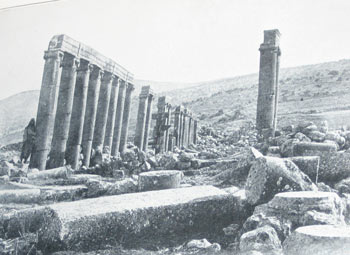
Gerasa of the Decapolis, Jerash c. 1900 -- Library of
Congress collection
This was another place Gerasa/Jerash, a city of the Decapolis about 30 miles south-east of the Sea of Galilee.
Parable of the Mustard Seed
A Mustard Field Along Highway 87-North Shore of Galilee
Mustard Seeds in the Palm of a Hand
Mustard Flowers
Giant Mustard
Upper Most Seats of the Synagogue
The Fig Tree
Mt of Olives Fig Tree, April 12-13, 2005
Fig and Pomegranite Trees Below Siloam in Jerusalem
Sycomore Fig Tree
The Good Shepherd
The Parable of the Sheep and the Goats
Goat Herder
Camels
Ritual Cleansing
Shechem
The Olive Harvest of Samaria
Mt. Ebal
Olive Tree
Pearl of Great Price
A First Century Synagogue at Gamala
Overview of Gamala
Modern Galilee Fishing Boats
Kursi
Caves and/or Tombs
Steep Slope Near Kursi
Hippos
Feeding the 5,000
On the Mountain
Walking on Water
Ramot-Tzelon area
Mt. Hermon
The Pools of Bethesda in Jerusalem
Healing Pools
Crusader Chapel and St. Ann Church
Pool of Siloam in Jerusalem
Hezekiah's Tunnel
Overlook to Siloam
Tower of Siloam
A Watch Tower in a Vineyard/Olive Grove
Grape Vines at Beth Horan
Towers
Mt. Precipice
South Face
Summit
Over the edge
Measuring Line
View of Nazareth from near Megiddo
Nazareth
The Basilica of the Annunciation
Capernaum
Healing a Paralytic in Capernaum
Bethsaida
Waterskins and Wineskins
The Fish and the Coin
Barbel
A Denarius
Casting Out a Demon
The Road to Jericho
Old Roman Road
Wilderness Above Jericho
Old Jericho
Western Wall
Gethsemane and the Cave of Gethsemane
Church of the Holy Sepulcher
Rolling Stone Tombs - Jerusalem
Other Rolling Stone Tombs
Tiberias
Solar Power in Israel
Salt of the earth
Chorazin
OTHER WEB SITES BY DAVID HALL:
Israel Photos VI
Israel Photos V -- Spring 2011
Israel Photos IV -- Pilgrimage
DQHALL.COM